
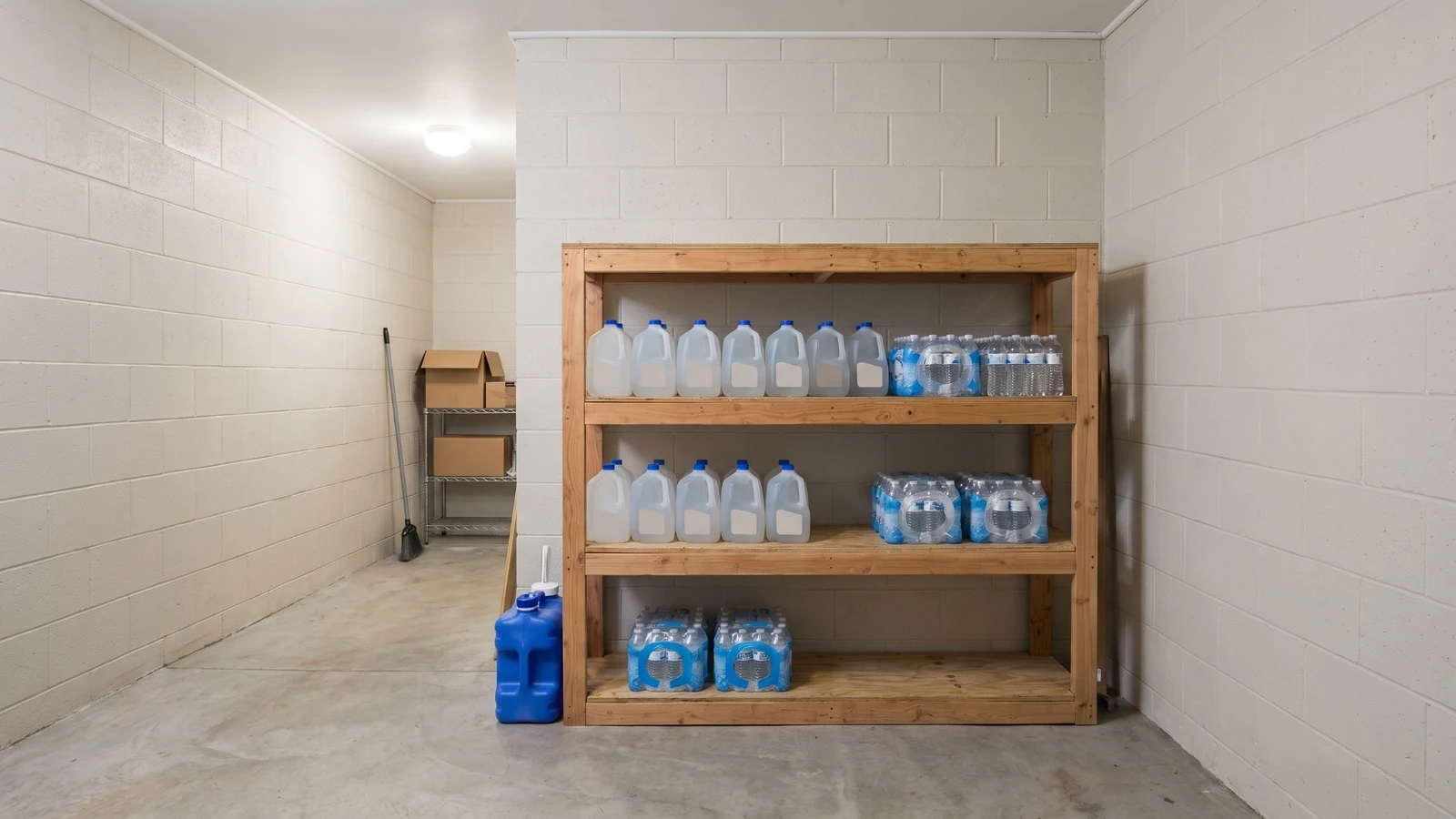
Quick Answer
CDC says to store at least 1 gallon of water per person per day for 3 days and to try for a 2-week supply if possible. For a household of four, that baseline is 12 gallons for 3 days or 56 gallons for 2 weeks, before additional needs.
Then plan separately for anything that may increase your household's needs, including pets, hot weather, pregnancy, illness, infants or formula preparation, and medical-specific needs. The 1-gallon figure is an official planning baseline—not a personalized total for every household.
The Official Emergency-Water Baseline
The starting point is simple:
1 gallon × number of people × number of days
CDC recommends storing at least 1 gallon of water per person per day for 3 days. That water is intended for emergency household uses including drinking, cooking, brushing teeth, and other needs. CDC also says to try to store a 2-week supply if possible.
That does not mean every household has the same final number. CDC specifically says to consider storing more water for pregnant women, people who are sick, pets, and people living in hot climates.
The useful distinction is:
Official baseline ≠ personalized household total.
Start with the official number. Then add the needs that are real for your household instead of replacing the baseline with a made-up universal multiplier.
Calculate Your Household Baseline
Use this formula:
Baseline gallons = people × days × 1 gallon per person per day
These are arithmetic examples based on the CDC baseline:
Swipe to view full table
| Household | 3-day baseline | 14-day goal |
|---|---|---|
| 1 person | 3 gal | 14 gal |
| 2 people | 6 gal | 28 gal |
| 4 people | 12 gal | 56 gal |
| 6 people | 18 gal | 84 gal |
For example, a household of four planning for 3 days calculates:
4 people × 3 days × 1 gallon = 12 gallons
If that same household is building toward 2 weeks:
4 people × 14 days × 1 gallon = 56 gallons
Those numbers are not promises that the household will have exactly the right amount for every circumstance. They are the official baseline translated into household totals.

What a 2-Week Supply Actually Looks Like
The math is easy. The physical scale is what often changes the plan.
USGS uses an approximate conversion of 8.34 pounds per U.S. gallon of water. Using that conversion, the water alone weighs approximately:
Swipe to view full table
| Household | 3-day water weight | 14-day water weight |
|---|---|---|
| 1 person | 25 lb | 117 lb |
| 2 people | 50 lb | 234 lb |
| 4 people | 100 lb | 467 lb |
| 6 people | 150 lb | 701 lb |
Container weight is additional. These figures are provided only to make the scale of the stored water easier to understand. They are not structural or load-bearing guidance for floors, shelves, balconies, or other surfaces.
For a family of four, the 2-week baseline is 56 gallons—about 467 pounds of water before the containers themselves are counted. That is why a good water plan is not just a number. It also has to be accessible, manageable, and practical to rotate.

When You Should Plan for More
The 1-gallon baseline is where the calculation starts. It is not a reason to ignore circumstances that may increase demand.
Pets
Treat pet water as a separate line item in your plan. Do not assume one fixed amount works for every animal. Needs can vary with species, size, diet, climate, activity, and health. If a precise amount matters for an animal in your household, use appropriate veterinary guidance.
Hot weather
CDC specifically says to consider storing more water if you live in a hot climate. There is no single Homestead Unlocked multiplier applied here. Build the official baseline first, then make a deliberate household-specific addition.
Pregnancy or illness
CDC also identifies pregnancy and illness as reasons to consider more water. This article does not assign a universal medical multiplier or individualized hydration target.
Infants, formula, and medical-specific needs
Some households have water needs that are not captured well by a generic baseline. If your plan includes infant feeding, formula preparation, powered or water-dependent medical equipment, or another specific medical need, follow the instructions and professional guidance that apply to that situation.
The planning principle is straightforward: do not hide special needs inside an invented average. Add them explicitly.
Build Your Water Supply in Stages
A 2-week target can become physically large very quickly. You do not have to treat the entire goal as one purchase or one storage project.
Use this six-step method:
1. Count the people
Who is expected to depend on the stored supply? Use the actual household count.
2. Choose the planning period
Start with the 3-day baseline. If space and budget allow, build toward 2 weeks. CDC presents 2 weeks as a longer preparedness goal to try for if possible; the starting baseline remains at least 3 days.
3. Calculate the baseline
Multiply:
people × days × 1 gallon
Keep this number separate from any household-specific additions.
4. Add real household needs
Create separate line items for pets, hot-weather needs, pregnancy, illness, infant/formula needs, or other circumstances that matter in your home.
5. Make the plan storable
A mathematically correct water plan is not very useful if the containers are too heavy to handle, difficult to reach, or impossible to rotate. Choose a storage approach your household can realistically manage.
6. Build in stages
If the 2-week amount is not practical immediately, reach the 3-day baseline first. Then add toward the longer goal as your space and budget allow.

Bottled Water vs. Filled Containers
CDC says unopened, commercially bottled water is the safest and most reliable source of water in an emergency.
If you are filling your own containers, CDC recommends using FDA-approved food-grade water storage containers when possible. This article is focused on how much water to plan for, so detailed container selection, cleaning, sanitizing, and storage procedures belong in a separate storage guide.
For this quantity plan, the important point is that your storage method should match the amount you calculated and remain practical to access and maintain.
How to Keep the Plan Maintainable
Emergency water should not become a forgotten number on a checklist.
A simple maintenance routine is enough for W01:
- Record what you have and where it is stored.
- Label home-filled containers as “drinking water” and include the storage date.
- CDC says to replace home-filled stored water every 6 months.
- Observe the expiration date for store-bought water.
- Keep container sizes realistic for the people who may need to move or use them.
- Revisit the household count and additional needs when your household changes.
Detailed storage conditions and sanitizing procedures should be handled as a separate safety-focused task rather than improvised from memory.
Common Water-Planning Mistakes
Treating 1 gallon as a personalized universal total
It is a baseline. CDC explicitly identifies circumstances where households should consider more.
Forgetting pets or other household-specific needs
Calculate the human baseline first, then add the needs that actually apply to your household.
Buying containers that are too difficult to handle
The 2-week goal can represent hundreds of pounds of water. Make sure the way you divide that volume is practical for the people who may need to access it.
Planning only for purification later
Treatment is an important backup capability, but it is not the same thing as having a stored emergency supply ready when normal water service is unavailable or unsafe. Start with stored water, then build other water-resilience layers separately.
Turning a quantity article into a treatment manual
Knowing how many gallons you need is one decision. Safe storage, filtration, purification, and container selection are separate decisions that deserve their own source-controlled guidance.
Emergency Water Checklist
Use this as a quick planning check:
- [ ] Count the people who will depend on the supply.
- [ ] Calculate at least 3 days at 1 gallon per person per day.
- [ ] Decide whether you can build toward a 2-week supply.
- [ ] Add pets and other household-specific needs separately.
- [ ] Consider additional water for hot climate, pregnancy, or illness where applicable.
- [ ] Check the physical weight and handling reality of the total volume.
- [ ] Use a storage approach you can access and maintain.
- [ ] Record storage or product dates.
- [ ] Review the plan when household needs change.
Frequently Asked Questions
How much emergency water does a family of four need?
Using the CDC baseline, four people need 12 gallons for 3 days. A 2-week baseline is 56 gallons. Those amounts come before household-specific additions for pets, hot weather, pregnancy, illness, or other needs.
Is 1 gallon per person per day enough for every household?
No single number is a personalized guarantee for every household. CDC uses at least 1 gallon per person per day as the emergency storage baseline and says to consider storing more for certain circumstances. Use the baseline first, then add the needs that actually apply to your household.
Do I have to store 2 weeks of water?
CDC says to store at least a 3-day supply and to try for a 2-week supply if possible. The 2-week amount is a longer preparedness goal that CDC says to try for if possible.
What is the 1 gallon per person per day supposed to cover?
CDC says the stored water can be used during an emergency for drinking, cooking, brushing teeth, and other uses. Homestead Unlocked does not split that gallon into unsupported fixed sub-quotas.
Is bottled water better than filling my own containers?
CDC describes unopened, commercially bottled water as the safest and most reliable emergency source. If you fill containers yourself, use appropriate food-grade storage containers and follow current CDC storage guidance.
How much does 56 gallons of water weigh?
Using the USGS approximation of 8.34 pounds per gallon, 56 gallons of water weighs about 467 pounds. Container weight is additional. This is scale and handling context, not structural-load advice.
How often should I replace water I store in containers myself?
CDC says to replace home-filled stored water every 6 months. For store-bought water, observe the expiration date.
Can I rely on a filter or purifier instead of storing water?
A filter or purification method can be part of a broader backup plan, but it does not replace the value of having a stored emergency water supply ready to use. This article focuses on quantity; treatment decisions should follow current guidance for the water source and the specific hazard involved.
Sources & Methodology
Homestead Unlocked treats official public-health guidance as the authority for the emergency-water baseline and clearly separates that guidance from our arithmetic examples and planning context.
Controlling source
- Centers for Disease Control and Prevention (CDC), *How to Create an Emergency Water Supply* — baseline quantity, 3-day minimum, 2-week goal if possible, additional-needs language, bottled-water guidance, and home-filled water rotation.
Supporting source
- Ready.gov, *Build A Kit* — supports the federal preparedness baseline for stored emergency water.
Weight conversion
- U.S. Geological Survey (USGS), *Hydraulic Conversion Tables* — approximately 8.34 pounds per U.S. gallon of water.
Homestead Unlocked calculations
- Household gallon totals are arithmetic applications of the CDC baseline.
- Water-weight examples multiply gallons by approximately 8.34 lb/gal and are rounded for readability.
- No Homestead Unlocked multiplier is applied for pets, climate, pregnancy, illness, infants, or medical needs.
Source freshness check: September 1, 2026.
Plan the Rest of Your Home Preparedness
Water quantity is one part of a practical household plan. Start with the baseline, make the total realistic for your household, and build the rest in layers.
Explore the Homestead Unlocked Water hub: /water