
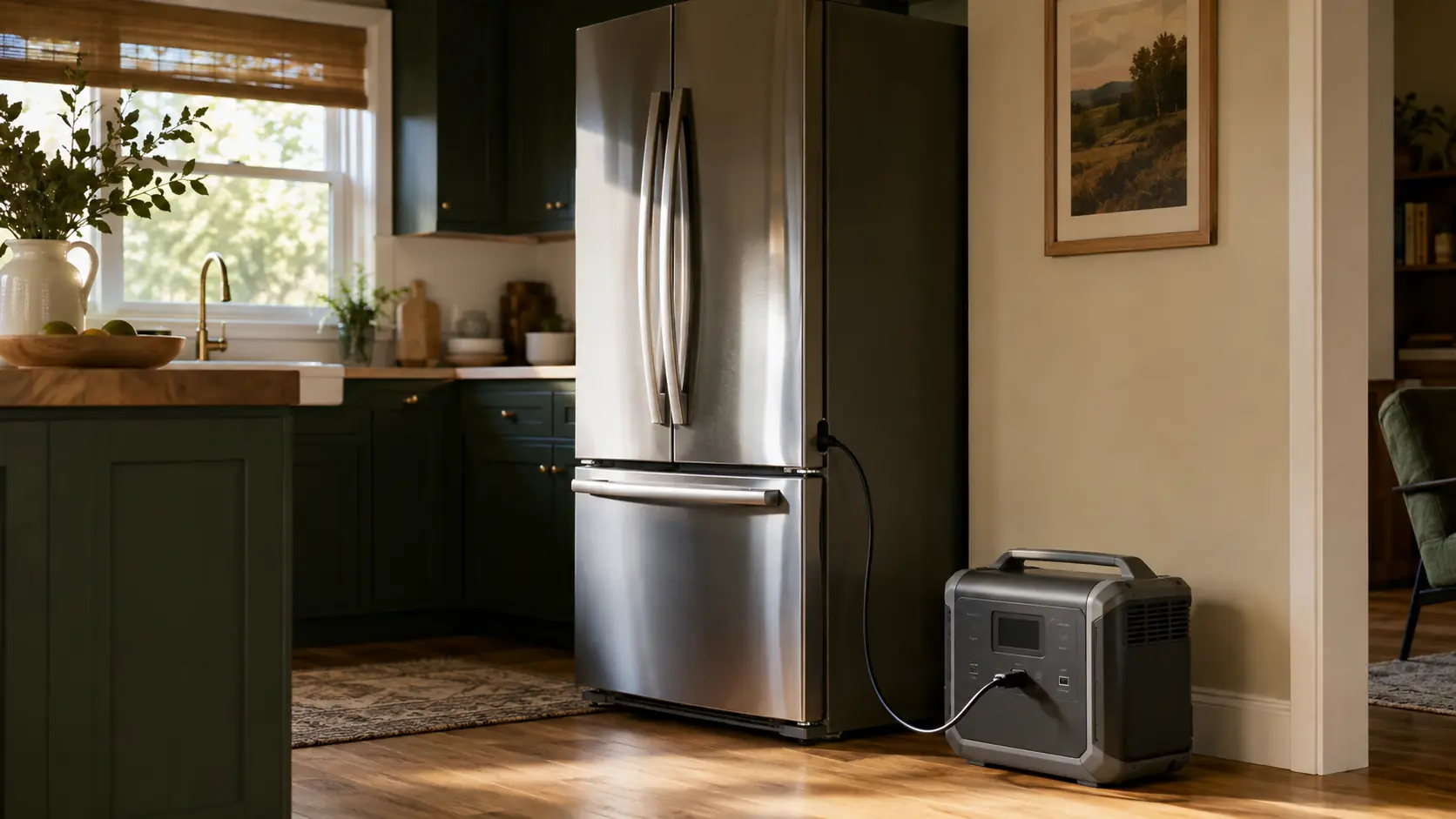
A portable power station can run many household refrigerators, but there is no reliable universal runtime. The best estimate starts with your refrigerator’s measured energy use—or its EnergyGuide annual kWh rating—not just a wattage number. Then compare that energy requirement with the power station’s planned usable AC energy and separately verify that the inverter can handle compressor startup.
This measurement-first method gives you a useful planning range without pretending that every refrigerator, kitchen, battery, and outage behaves the same way. It also explains why two power stations with the same watt-hour rating may produce different real-world results.
The Three Numbers You Actually Need
You need three different pieces of information. They answer different questions and should not be collapsed into one headline specification.
- Refrigerator energy use: how many watt-hours the appliance consumes over a representative day. Measurement is best; EnergyGuide annual kWh is the strongest practical fallback.
- Planned usable power-station energy: the portion of rated battery capacity you plan to deliver to an AC appliance after a conversion allowance and reserve.
- Output and startup requirements: whether the station’s inverter can supply the refrigerator’s running power and documented compressor startup demand.
Watts describe power at a moment in time. Watt-hours describe energy used over time. The U.S. Energy Information Administration explains that a watt is a unit of power, while a watt-hour represents electricity use over time; one kilowatt-hour equals 1,000 watt-hours. Runtime depends primarily on energy. Starting the compressor depends on power. You must check both.
Best Method: Measure Your Refrigerator
A plug-in electricity meter can track how much energy your refrigerator actually uses in your home. If the meter reports kilowatt-hours, convert the reading to a 24-hour basis:
Daily refrigerator Wh = measured kWh × 1,000 × (24 ÷ measurement hours)
For example, a reading of 2.4 kWh collected over 48 hours converts to 1,200 Wh per day. The formula normalizes a 24-, 48-, or 72-hour reading to the same daily unit used by the estimator.
Measurement captures the cycling behavior that a running-watt label cannot. It can reflect your refrigerator’s model, settings, condition, ambient temperature, door use, defrost cycles, and attached features during the measurement period. It still does not guarantee future consumption, because conditions can change.
Use a meter only as directed by its manufacturer and within its electrical rating. If the appliance connection, outlet, cord, or measurement setup raises any concern, stop and use model documentation or qualified help instead.
How Long Should You Measure?
Measure for at least 24 hours so the reading includes normal compressor cycling. A 48- or 72-hour period can better include variations such as defrost cycles, changing room temperature, meal preparation, and normal door openings. Use a representative period rather than an unusually quiet day or a period immediately after loading the refrigerator with warm groceries.
Record both the energy reading and the exact number of hours. If conditions during an outage will be hotter than the measurement period, or if other loads share the battery, leave additional planning margin rather than treating the result as precise.
Second-Best Method: Use the EnergyGuide Label
If you cannot measure the appliance, look for its EnergyGuide annual energy-consumption figure in kWh/year. The Federal Trade Commission requires EnergyGuide labeling for covered appliances and explains that the estimates are based on Department of Energy test procedures. This makes the label useful for standardized comparison, but it is not the same as measuring the refrigerator in your home.
Convert annual kWh to daily watt-hours with this formula:
Daily refrigerator Wh = (EnergyGuide kWh/year × 1,000) ÷ 365
Use the figure for the exact refrigerator model when possible. Do not substitute the number from a different size, configuration, or model simply because the appliances look similar.
How to Calculate Refrigerator Runtime
First estimate planned usable AC energy. Homestead Unlocked uses an 85% AC planning factor and a 10% reserve as editable defaults in this estimator:
Planned usable AC Wh = rated power-station Wh × AC planning factor × (1 − reserve)
These are HU planning assumptions, not universal efficiency constants, manufacturer guarantees, or runtime guarantees. Replace them with product-specific information or a different reserve when you have a better basis.
Then divide planned usable AC energy by the refrigerator’s average hourly energy demand:
Estimated runtime hours = planned usable AC Wh ÷ (daily refrigerator Wh ÷ 24)
Interactive planning tool
HU Refrigerator Runtime Estimator
Use your refrigerator’s own energy data. The result is a transparent planning estimate, not a runtime guarantee.
Enter your data and select Estimate runtime to see the math.
Why Refrigerator Running Watts Can Mislead You
A refrigerator compressor cycles on and off. The running or input watts shown at one moment do not mean the appliance draws that amount continuously for 24 hours. Multiplying running watts by 24 can therefore produce a poor estimate unless you also have a realistic operating percentage.
When measurement and EnergyGuide data are unavailable, a rough fallback is:
Daily refrigerator Wh = running watts × 24 × estimated operating percentage
The operating percentage must come from the user; HU does not invent a universal duty cycle. Actual cycling changes with the appliance, temperature, door openings, defrost operation, seals, contents, and settings. The estimator labels this method ROUGH ESTIMATE because uncertainty is materially higher.
Can the Power Station Actually Start the Refrigerator?
Enough energy does not automatically mean enough power. A station may have ample battery capacity but an inverter that cannot start or sustain the compressor.
Compare the refrigerator’s documented running or input requirement with the station’s continuous AC output. Separately compare the refrigerator’s documented startup requirement with the station’s relevant startup or surge rating, including any stated time limit or operating condition.
Do not assume a universal 2×, 3×, or 4× startup multiplier. Refrigerator designs and manufacturer specifications vary. If the startup requirement is unknown, the responsible result is not verified, not a guessed number. Check the exact refrigerator documentation or ask its manufacturer, then compare that information with the station manufacturer’s specifications.
The estimator keeps this output check separate from runtime. It can show that energy appears sufficient while the entered power requirements fail, or that the runtime estimate exists while startup compatibility remains unverified.
What Changes Refrigerator Runtime in the Real World?
No simple calculator captures every operating condition. Runtime can change because of:
- Ambient temperature: a warmer kitchen or garage can increase cooling demand.
- Door openings: warm air enters each time the door opens.
- Appliance size and model: construction, controls, compressor design, and configuration differ.
- Age and efficiency: condition and component performance can change over time.
- Compressor cycling: cycling responds to temperature, settings, and load.
- Defrost cycles: automatic defrost systems add intermittent energy use.
- Ice makers and dispensers: attached features may add loads when active.
- Door seals: damaged or poorly sealing gaskets can increase cooling work.
- Inverter and system losses: delivered AC energy varies by station and conditions.
- Other attached loads: anything else connected to the station reduces available energy.
- Environmental conditions: battery temperature and operating limits can affect performance.
Because these factors vary, report the result as a planning estimate and preserve a reserve. Re-measure when seasons, settings, appliance condition, or usage patterns change materially.
Will a 1,000Wh Power Station Run a Refrigerator Overnight?
It might, but “1,000 Wh” alone cannot answer the question. Calculate planned usable AC energy using the station information and your selected reserve. Then divide by the refrigerator’s measured daily Wh converted to hourly demand. Finally, verify continuous output and compressor startup separately.
For example, do not copy the hypothetical refrigerator above and call it typical. Enter your own 24–72 hour measurement or exact-model EnergyGuide figure. If the estimated runtime covers your intended overnight period with a prudent margin and the power checks clear, the plan has a stronger evidence base. It is still not a guarantee.
What About a 2,000Wh Power Station?
Use exactly the same method. A larger rated battery generally creates more planned usable energy when all other assumptions are equal, but it does not reveal the refrigerator’s consumption, the inverter’s startup capability, or the station’s recharge constraints.
Enter 2,000 Wh as the rated capacity, use your own refrigerator data, disclose the AC factor and reserve, and review the transparent result. A larger capacity does not remove the need for startup verification or reasonable margin.
What About Multi-Day Outages?
For multi-day backup, runtime is only half the system. Recharging becomes part of the plan. Estimate the refrigerator’s daily energy requirement, then determine whether grid access, solar input, a vehicle source, or another manufacturer-approved charging method can reliably replace that energy under expected conditions.
Review charging-input limits, available charging hours, environmental constraints, and whether the station can power loads while charging. Solar nameplate watts do not guarantee daily energy production. Weather, orientation, shade, temperature, controller limits, and the station’s input window all matter.
To plan refrigeration alongside lights, communications, pumps, or other essentials, first decide what should receive power first during a blackout, then size your full backup-power requirement rather than allocating the entire battery to the refrigerator. You can also compare how a portable power station and a fuel generator fit different outage plans without assuming one architecture is always better.
How to Make Available Battery Energy Last Longer
Keep refrigerator and freezer doors closed as much as practical. Decide what you need before opening a door, and avoid repeated checks. Do not add warm items during an outage if that can be safely avoided.
Power only the loads you have deliberately included in the plan. Disconnect unneeded AC devices from the station, because every added load consumes part of the available energy. Use the station and refrigerator within their manufacturer operating requirements, and keep ventilation openings clear.
Measure before the next outage. A recent 48- or 72-hour reading gives you a better planning basis than a generic online wattage list. Recheck the estimate after changing refrigerator settings, moving the appliance, or adding battery-powered loads.
What to Look for in a Refrigerator Backup Power Station
Use your calculation as a filter, then compare candidates consistently:
| Check | What to verify |
|---|---|
| Rated capacity | Enough nominal Wh to cover the modeled energy requirement with disclosed assumptions |
| Continuous output | Above the refrigerator’s documented running/input requirement |
| Startup or surge capability | Clears the documented startup requirement under the manufacturer’s stated conditions |
| Recharge speed | Can replenish the expected daily energy before the reserve is exhausted |
| Solar input | Appropriate voltage, current, connectors, and realistic charging opportunity |
| Expandability | Supports additional capacity if the backup window or load list grows |
| Usable-energy evidence | Manufacturer data or independent evidence relevant to AC delivery and test conditions |
This launch is brand-neutral. Capacity and output fit come before price, merchant, or promotion.
Refrigerator Backup Checklist
- Find the exact refrigerator model.
- Measure kWh over 24–72 representative hours when practical.
- If measurement is unavailable, use the exact-model EnergyGuide annual kWh.
- Treat running watts plus an operating estimate as a rough fallback only.
- Record the station’s rated Wh, continuous output, and surge/startup specification.
- Find the refrigerator’s documented running and startup requirements; do not invent a multiplier.
- Calculate planned usable AC Wh with disclosed assumptions.
- Calculate estimated runtime and preserve a reserve.
- Account for every other load connected to the station.
- Plan how and when the station will recharge.
- Keep current FDA food-safety guidance available for an actual outage.
Frequently Asked Questions
How long can a power station run a fridge?
Divide the station’s planned usable AC watt-hours by the refrigerator’s average watt-hours per hour. Derive refrigerator demand from measured kWh over 24–72 hours when possible, or from the exact-model EnergyGuide annual kWh. Then verify startup power separately.
Can a power station start a refrigerator?
Some can, but capacity alone does not establish that. Compare the refrigerator’s documented running requirement with continuous output and its documented startup requirement with the station’s relevant startup or surge specification. If startup data is missing, compatibility remains unverified.
Is the EnergyGuide number accurate for my home?
EnergyGuide is a standardized estimate based on federal test procedures, useful for comparison and planning. It is not a measurement of your appliance in your kitchen. Your temperature, settings, use, appliance condition, and environment can produce different consumption.
Should I use watts or watt-hours?
Use both for different checks. Watt-hours help estimate runtime. Watts help determine whether the inverter can run and start the refrigerator.
Does a 2,000Wh station run a refrigerator twice as long as a 1,000Wh station?
Not as a universal promise. Under identical assumptions and operating conditions, doubling planned usable energy doubles the mathematical runtime estimate. Actual stations may differ in conversion behavior, reserve settings, inverter design, limits, temperature, and other loads.
Is this estimator a food-safety tool?
No. It estimates battery runtime. Follow FDA time-and-temperature guidance for food safety during an outage; do not use a remaining-battery estimate to declare food safe.
For the food-safety timeline and temperature checks, read Food Safety During a Power Outage: Refrigerator and Freezer Timeline.
Sources & Methodology
Homestead Unlocked prioritizes primary and official sources for factual and safety claims. This article uses measurement first, exact-model EnergyGuide information second, and user-supplied running watts plus an operating estimate only as a clearly labeled rough fallback. Calculations are deterministic planning models, not product tests or guarantees.
- U.S. Food and Drug Administration — Food and Water Safety During Power Outages and Floods
- Federal Trade Commission — Energy and Water Use Labeling / EnergyGuide Rule
- Federal Trade Commission — EnergyGuide Labeling FAQs
- U.S. Energy Information Administration — Measuring Electricity
The 85% AC planning factor and 10% reserve are editable HU planning defaults. They are not universal technical constants, manufacturer guarantees, or runtime guarantees. No merchant supplied, sponsored, or reviewed this launch article.
Size the rest of your backup loads