
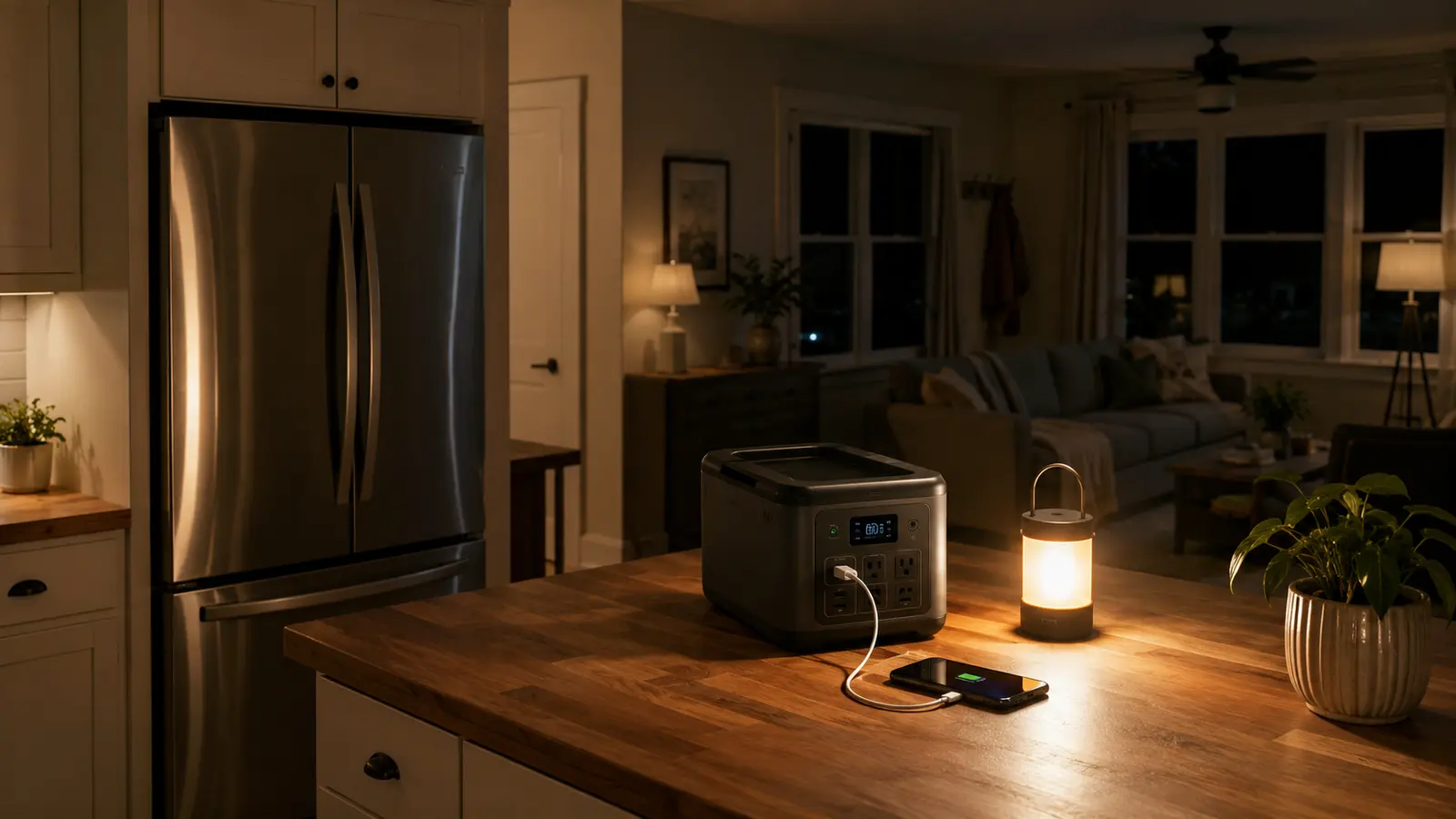
Start with consequence, not appliance size. Protect immediate life and safety needs first, then preserve communications and time-sensitive household systems. Use the remaining energy for the loads that avoid the greatest consequence per watt-hour. The exact order changes with your household, weather, outage duration, water dependence, flooding risk, health needs, and local infrastructure.
Most blackout checklists list gear. This guide teaches allocation: decide what matters, estimate how much energy each service needs, and direct limited battery or fuel toward the most important outcome.
Why “What can I run?” Is the Wrong First Question
“What can I run?” starts with equipment capability. A safer plan starts with the household consequence of losing a service. A 10-watt phone charger may preserve alerts and emergency contact. A refrigerator may protect food, but an unopened refrigerator also has a limited cold window before electrical backup becomes urgent. A pump may consume far more power, yet move to the top when it protects the household’s water supply or prevents active flooding.
Backup energy is always limited. A battery has a finite number of planned usable watt-hours. A generator depends on safe outdoor operation, available fuel, and maintenance. Even a large system can be overwhelmed by an unranked list of simultaneous loads.
For noncritical loads, ask: “What consequence do I avoid per watt-hour?” Use that question only after life and immediate safety needs have been identified. Safety is not traded against efficiency.
The HU Blackout Priority Framework
Use this as a default visual shorthand, not universal law:
CRITICAL → COMMUNICATION → FOOD → LIGHT → COMFORT
The five tiers translate the shorthand into a decision framework:
Swipe to view full table
| Tier | Default role | Examples | Control rule |
|---|---|---|---|
| Tier 0 — Immediate life / safety | Protect people from an immediate consequence | Household-specific powered medical equipment; urgent safety equipment; smoke or CO alarms where backup is relevant to the device | Follow device, clinician, and emergency-plan guidance. Do not treat a generic backup estimate as a continuity guarantee. |
| Tier 1 — Communications & awareness | Maintain alerts, contacts, and an alternate information path | Phone charging; emergency radio; essential local connectivity | Powering a router or modem does not guarantee that upstream internet service remains available. |
| Tier 2 — Prevent time-sensitive loss | Act before a known consequence becomes harder to avoid | Refrigerator or freezer after considering the FDA cold window; relevant sump pump; critical private-well service | Priority depends on timing and consequence. Verify actual electrical and startup requirements. |
| Tier 3 — Safe basic function | Keep the smallest useful set of ordinary functions | Task lighting; limited fans; small electronics; selected water or comfort loads | Use the smallest load that solves the problem instead of powering a whole room or house. |
| Tier 4 — Comfort & convenience | Add optional service after the plan is stable | Entertainment; nonessential charging; redundant lighting; convenience appliances | Use only after essential needs, reserve, and replenishment are covered. |
Another useful planning graphic is:
PRIORITY = CONSEQUENCE + TIME + ENERGY
Consequence asks what happens if the load stops. Time asks when that consequence becomes important. Energy asks what the load consumes and what your backup source can safely sustain. None of those three factors works alone.
Step 1: Identify Safety and Genuinely Critical Loads
Begin with people, not appliances. Identify any load whose interruption could create an immediate health or safety consequence for this household. Powered medical equipment may belong here, but this article does not size medical devices or guarantee continuity. Follow the device manufacturer’s requirements and the emergency plan developed with the relevant clinician or care team. Know the appropriate local emergency and relocation options before an outage.
Smoke and carbon-monoxide alarms should be maintained according to their manufacturer instructions. Some are battery-powered or include battery backup; do not assume a portable power source is required or compatible without checking the exact device and setup.
Extreme heat or cold can also change what “critical” means. A fan or small battery does not make dangerous heat safe, and improvised indoor-combustion heating is not a safe backup plan. Current local alerts, safe shelter or relocation options, hydration, and household-specific medical guidance can outrank ordinary appliance use.
Step 2: Preserve Communications and Information
Phone charging is often a high-value, low-energy load. A charged phone can support alerts, calls, messages, maps, and coordination, subject to the availability of cellular service. Reduce screen brightness, use low-power mode, and avoid unnecessary background use when charging opportunities are uncertain.
Plan a second information path. A battery-powered or hand-crank radio can remain useful when local cellular or internet service is disrupted. Know how your phone, internet, and any landline service behave when utility power fails.
A powered router and modem can preserve home connectivity only if upstream equipment and the provider’s network remain operational. Router power does not guarantee internet service. Do not spend a large share of the energy budget on local networking without an alternate path for alerts.
Step 3: Protect Food — but Use the Clock
Food protection is important, but it is a time-based priority rather than an automatic minute-one load. Current FDA guidance says to keep refrigerator and freezer doors closed as much as possible. An unopened refrigerator keeps food cold for about 4 hours. A full freezer holds its temperature for about 48 hours, or about 24 hours when half full, if the door stays closed.
Swipe to view full table
| Appliance state | FDA food-safety window with door kept closed | Immediate action |
|---|---|---|
| Refrigerator, unopened | About 4 hours | Keep the door closed; monitor time and temperature. |
| Full freezer, unopened | About 48 hours | Keep the door closed and preserve the cold. |
| Half-full freezer, unopened | About 24 hours | Keep the door closed and preserve the cold. |
During a short outage, keeping the door closed may preserve more value than immediately powering the refrigerator. As the outage extends, refrigeration can rise in priority. To estimate the equipment side separately, use the refrigerator runtime guide and estimator.
Step 4: Keep Only the Lighting and Basic Function You Need
Choose task lighting over whole-room lighting. One efficient light where people are cooking safely, reading instructions, or moving through a hazard area can be more useful than illuminating several unused rooms. Prefer battery-powered flashlights or lanterns to candles.
Apply the same “smallest load that solves the problem” rule to other functions. Charge one shared device before several optional devices. Run a limited fan where it provides meaningful relief rather than treating it as a substitute for a safe heat plan. Coordinate water use if a private well or pump is unavailable.
Well pumps, sump pumps, refrigerators, freezers, and other motor loads require more than an energy estimate. Check the exact continuous input and documented startup requirement separately. A source can contain enough watt-hours and still be unable to start the motor. Do not assume compatibility from a generic wattage list or a battery-capacity number.
Step 5: Decide What Can Wait
Entertainment, redundant lights, convenience appliances, and nonessential charging belong after the essential plan is working. “Can wait” does not mean “never.” It means the load is the first to defer when energy, fuel, or recharge opportunity becomes scarce.
Some high-power conveniences can consume a day’s communication and lighting budget in a short period. Before connecting one, compare the avoided consequence with the energy it consumes. Preserve a reserve for uncertainty rather than planning to use every available watt-hour.
When the Priority Order Changes
The same load can move between tiers as conditions change:
Swipe to view full table
| Condition | What may move up | Why | Planning control |
|---|---|---|---|
| Medical dependence | A specific powered device or refrigerated medicine | Interruption may create an immediate health consequence | Use device, clinician, pharmacy, and emergency-plan guidance; do not promise continuity. |
| Extreme heat | Safe cooling access, hydration, communication, or relocation | Heat can become life-threatening | Do not imply that a small battery makes unsafe heat safe. |
| Extreme cold | Safe heating or relocation planning | Loss of heat can become urgent | Never improvise indoor combustion heating. |
| Private well | Water service | Loss of electricity may also mean loss of household water | Verify the exact pump’s voltage, continuous input, startup demand, and approved connection method. |
| Flood or heavy rain | Sump pump | Delay can increase property damage | Verify startup power and safe setup; this guide provides no wiring or installation instructions. |
| Cell or internet disruption | Radio or alternate communication | Local equipment may have power while upstream service is unavailable | Maintain more than one information path. |
| Short outage | Communications and immediate safety may remain above refrigeration | Closed cold storage may retain safe temperature for a limited window | Keep doors closed and monitor the FDA food-safety clock. |
| Long outage | Refrigeration, water, climate, and replenishment | Stored energy alone eventually runs out | Move from a one-time battery budget to a sustainable recharge or refuel plan. |
Reassess rather than locking the list on day one. Weather worsens, a freezer approaches its time limit, communications fail, or a sump pump begins cycling. The plan should change when the consequence and timing change.
Turn Priorities Into an Energy Budget
Use this sequence:
LOAD → CONSEQUENCE → PRIORITY → WH/DAY → BACKUP PLAN
- List every load the household might want during an outage.
- Mark each load as
must-run,time-sensitive,useful, orcan-wait. - Write the consequence of losing it and when that consequence begins.
- Estimate daily watt-hours using measured or device-specific data where practical.
- Check continuous and startup power separately for pumps, compressors, and other motor loads.
- Allocate available battery or fuel to the highest-consequence loads first.
- Reassess as outage duration and conditions change.
- Determine how the system will recharge or refuel before treating the plan as sustainable.
Swipe to view full table
| Load | Classification | Consequence if unavailable | Wh/day | Continuous / startup check | Backup plan |
|---|---|---|---|---|---|
| Phone charging | Must-run or time-sensitive | Reduced access to alerts and contacts | Use measured charger energy | Continuous only for most chargers; follow device requirements | Battery bank or approved backup source, plus alternate radio |
| Refrigerator | Time-sensitive | Food may enter an unsafe temperature window | Measure over a representative period | Compressor startup checked separately | Closed-door cold window, then a verified source and reserve |
| Task light | Useful or must-run by location | Reduced safe movement or task visibility | Watts × hours used | Continuous | One efficient light in the needed area |
| Pump | Household-specific, sometimes must-run | Loss of water or increased flood risk | Measure or use exact documentation | Continuous and startup both required | Verified compatible source; qualified guidance where needed |
Watt-hours answer how much energy a load uses over time. Watts answer whether the source can handle the power demand at a moment. Priority answers why and when the load should receive energy. Keep all three questions separate.
When the list is complete, use the power-station sizing guide to calculate capacity, continuous output, startup capability, and recharge needs without turning the priority list into a product-shopping shortcut.
What About Generators?
A portable fuel generator follows the same load-priority logic. More output does not remove the need to rank loads, preserve fuel, understand startup demand, or plan for changing outage duration. The operating environment is also a hard safety constraint.
This guide does not provide backfeed, panel, interlock, transfer-switch, permanent-wiring, or electrical-installation instructions. Compare the portable options and the optional hybrid architecture in the power station vs. generator guide.
Blackout Priority Checklist
- Protect immediate life and safety needs.
- Preserve at least one communication channel and one alternate information path.
- Keep refrigerator and freezer doors closed; track time and temperature.
- List loads as
must-run,time-sensitive,useful, orcan-wait. - Write the consequence and timing for every load.
- Estimate Wh/day from your device data or measurements.
- Check continuous and startup power separately for motor loads.
- Use the smallest load that safely provides the needed service.
- Preserve an energy or fuel reserve for uncertainty.
- Reassess after changes in weather, health needs, water, flooding, communications, and outage duration.
- Confirm a realistic recharge or refuel path before calling the plan sustainable.
- Keep manufacturer instructions and local emergency information accessible offline.
Frequently Asked Questions
Should I power my refrigerator first during a blackout?
Not automatically. Keep the doors closed and use the FDA time-and-temperature guidance. Immediate medical, safety, communications, water, or flooding consequences may rank higher. Refrigeration usually rises as the cold window closes or measured temperatures require action.
What should a power station power first?
The highest-consequence verified load that the station can safely support—not the largest appliance. Identify life and safety needs, preserve communications, then allocate remaining watt-hours by consequence and timing. Check capacity, continuous output, and startup capability separately.
What should a generator power first?
Use the same conditional priority list. Generator output does not create a universal appliance ranking. Fuel, outdoor placement, weather, maintenance, continuous power, and startup requirements remain separate constraints.
Is food always more important than lighting?
No. Safe task lighting may be immediately necessary, while closed cold storage can retain temperature for a limited window. The answer changes with time, temperature, household needs, and the consequences of darkness in the specific setting.
Should I keep my router powered during an outage?
Only if connectivity is useful and upstream service remains available. A powered router and modem do not guarantee internet service. Preserve phone battery and maintain an alternate information path such as a battery-powered radio.
Where do well and sump pumps belong?
Wherever their real consequence places them. A well pump may become critical when it is the household’s only water source. A sump pump may become urgent during flooding. Verify the exact electrical, continuous, and startup requirements before assuming any backup source can operate the load.
How often should I revise the priority list?
Review it before outage season, after adding or replacing important equipment, and whenever household health, water, flood, climate, or communication needs change. During an outage, reassess when conditions or expected duration change.
Sources & Methodology
Homestead Unlocked developed this framework from current U.S. preparedness and safety guidance, then applied an allocation method that keeps consequence, timing, energy duration, and output compatibility distinct. It is not a government-mandated universal appliance ranking and does not replace device, clinician, manufacturer, utility, local emergency, or food-safety guidance.
Food-safety guidance was rechecked against the FDA on August 31, 2026. The FDA continues to advise keeping refrigerator and freezer doors closed as much as possible, with about 4 hours for an unopened refrigerator, about 48 hours for a full freezer, and about 24 hours for a half-full freezer when the door remains closed.
Portable-generator wording was rechecked against current CPSC guidance on August 31, 2026. CPSC continues to require outdoor-only operation at least 20 feet from homes and buildings, with exhaust away from openings, and recommends working CO alarms. Manufacturer instructions control operation, weather and shock hazards, maintenance, shutdown, cooling, and refueling for the exact equipment.
- U.S. Food and Drug Administration — Food and Water Safety During Power Outages and Floods
- CDC — Prepare Your Health: Power Sources
- Ready.gov — Power Outages
- U.S. Consumer Product Safety Commission — Generator Carbon Monoxide and Fire Hazards Ahead of Hurricane Season
- U.S. Consumer Product Safety Commission — Carbon Monoxide
This article is brand-neutral. No merchant supplied, sponsored, or reviewed it, and it contains no new merchant-specific affiliate links.
Size Your Backup System Around the Loads That Matter
Turn the ranked list into a capacity, output, and recharge plan with the practical power-station sizing guide. Then use the refrigerator and architecture guides when those decisions apply to your household.
Size your backup system around the loads that matter