
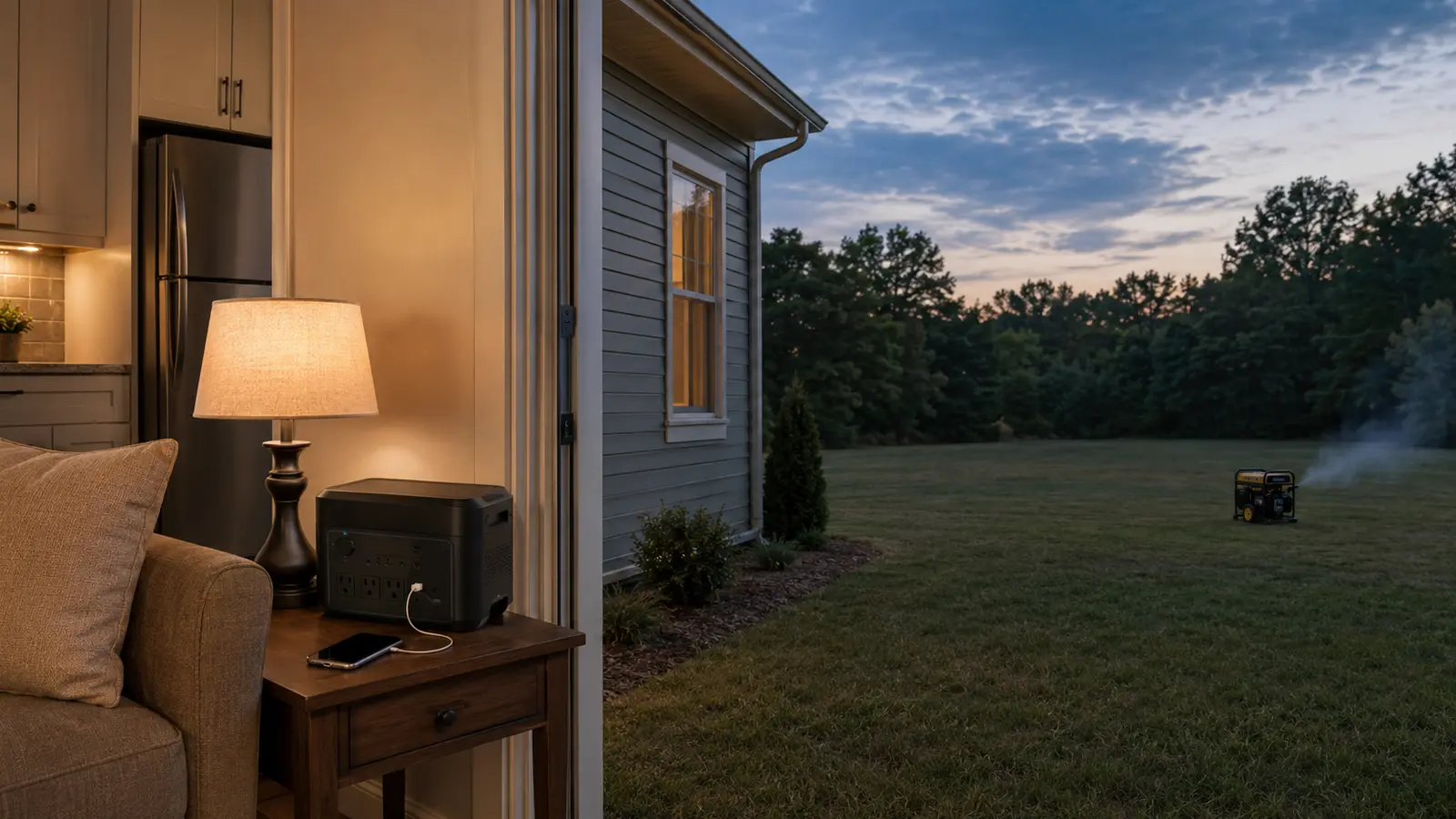
A portable power station and a portable fuel generator solve the same broad problem in very different ways. A battery power station is quiet at the point of use, produces no engine exhaust, and can support selected indoor loads when operated as directed. A fuel generator can keep producing power as long as you can safely operate it outdoors and obtain suitable fuel, but it brings carbon-monoxide, fire, weather, noise, storage, and maintenance constraints.
There is no universal winner. The better fit depends on four connected questions: LOADS + OUTAGE DURATION + RECHARGE/REFUEL + OPERATING ENVIRONMENT. Start with the services you need to preserve and the conditions in which the equipment must work. Only then compare equipment.
This guide compares portable equipment for selected household backup loads. It does not cover standby generators, home wiring, transfer equipment, backfeeding, panels, interlocks, or permanent electrical installation.
Start With the Outage, Not the Equipment
An outage plan should describe the job before it names the tool. Write down the essential loads, their energy use, their running and startup power, and how long they must operate. Then identify where the equipment can safely run and how its energy source will be replenished.
If the essential load list is still unsettled, use the blackout power-priority framework to rank services by consequence and timing before comparing equipment architectures.
Use these four planning questions:
- Loads: Which refrigerator, communications equipment, medical device, lighting, pump, or other essential load must operate? What are its documented running and startup requirements?
- Outage duration: Are you planning for a brief interruption, an overnight outage, or several days without grid power?
- Recharge or refuel: Can the battery receive enough energy from an available, manufacturer-approved source? Can the generator be refueled safely and can fuel be stored and obtained under expected conditions?
- Operating environment: Do you have a compliant outdoor generator location at least 20 feet from homes and buildings, with exhaust directed away from openings? Are noise, weather, fire risk, and maintenance manageable there?
The first step is measurement. Use our practical power-station sizing guide to build a load list and separate watt-hours from watts. Watt-hours help estimate duration. Continuous and startup watts help determine whether an output source can operate the load. Neither number replaces the other.
Power Station vs Generator: The Core Differences
The comparison is not simply “battery versus gas.” Each architecture changes how energy is stored, replenished, placed, and managed during an outage.
Swipe to view full table
| Planning dimension | Portable battery power station | Portable fuel generator | Optional hybrid architecture |
|---|---|---|---|
| Energy source | Stored electrical energy in a rechargeable battery | Mechanical engine converts stored fuel into electricity | Battery serves loads; generator can replenish it using manufacturer-approved methods |
| Runtime model | Finite stored watt-hours divided among connected loads | Continues while safe operation, fuel, maintenance, and equipment limits permit | Battery covers quiet periods; generator runtime can be consolidated into planned recharge windows |
| Indoor constraints | No engine exhaust at the point of use; follow battery ventilation, temperature, charging, and clearance instructions | Never operate indoors or in any enclosed or partly enclosed space | Generator remains outdoors under every operating condition; battery use follows its manual |
| Placement | Near selected loads if the manufacturer permits the environment and clearances | Outdoors only, at least 20 feet from homes and buildings, with exhaust away from openings | Requires a compliant generator location plus an appropriate battery location |
| Noise | Usually low noise aside from cooling fans and connected equipment | Engine noise is continuous while running | Quiet at the loads when the generator is off; engine noise remains during recharge |
| Maintenance | Battery care, storage state, inspection, firmware when applicable, and periodic readiness checks | Engine, fuel, oil, filters, storage, inspection, and manufacturer maintenance schedule | Requires readiness work for both systems |
| Startup and output | Inverter must meet continuous and documented startup demand | Generator output must meet continuous and documented startup demand | Each operating path must be checked separately |
| Recharge or refuel | Grid, solar, vehicle, or another approved input, subject to real input limits and availability | Suitable fuel, safe shutdown and refueling, storage limits, and local availability | Adds flexibility but also conversion losses, procedures, and more equipment |
| Long-outage fit | Strong only when realistic daily recharge can replace daily energy use | Can be strong when fuel and safe outdoor operation remain available | Can reduce generator operating hours while retaining a fuel-based replenishment option |
| Short, quiet outage fit | Often well suited to selected, measured loads | May provide more power than the plan needs while adding setup, noise, and safety burden | Usually more complexity than a short event requires |
| Hybrid role | Primary quiet energy buffer | Periodic replenishment source | Optional third architecture, not an automatic upgrade |
What a Portable Power Station Does Well
A portable power station stores electricity before the outage. That makes it useful when you need immediate, quiet power for a defined group of loads. There is no combustion engine, no fuel handling during normal battery operation, and no carbon-monoxide exhaust at the point of use.
That operating profile can suit apartments, attached homes, nighttime use, communications, lighting, and measured refrigerator loads—especially when a safe generator location is unavailable. It can also make routine testing easier: charge the station, connect only approved loads, and confirm that the real energy use and startup behavior match the plan.
Battery systems are particularly transparent when you work in watt-hours. If a station has a known planned usable energy amount and the connected loads have measured daily energy use, you can estimate a duration range and preserve a reserve.
Estimated runtime hours = planned usable AC Wh ÷ average load Wh per hour
That estimate is still conditional. Conversion losses, standby consumption, temperature, battery condition, and load cycling can change the result. The point is not precision to the minute; it is a repeatable planning method.
Where a Power Station Falls Short
Stored energy is finite. A large capacity number does not make a battery self-replenishing. In a multi-day outage, the critical question becomes whether the available charging source can replace the energy used each day.
Solar input may help, but panel nameplate watts are not daily watt-hours. Weather, shade, season, orientation, controller limits, battery temperature, and usable charging hours all affect production. Vehicle and grid charging also depend on access, equipment limits, and the manufacturer’s approved procedure.
Output can be a separate limit. Pumps, compressors, heating elements, cooking appliances, and multiple simultaneous loads may exceed continuous output or startup capability even when the battery contains enough energy. Do not infer startup compatibility from capacity. Compare documented appliance requirements with the station’s documented ratings.
What a Portable Generator Does Well
A portable fuel generator converts stored fuel into electricity while its engine runs. Its main planning advantage is replenishment: instead of waiting for sunlight or the grid, you can continue producing power when suitable fuel remains available and every operating condition can be met safely.
That can make a generator useful for higher-power loads, extended outages, or situations where daily battery recharge is otherwise inadequate. A generator may also provide substantial continuous output relative to many portable battery systems, although every load’s running and startup requirements still need to be checked against the exact model.
Where a Generator Falls Short
Portable generators introduce hazards and operating burdens that batteries do not. Carbon monoxide is invisible and odorless. The generator must remain outdoors, far from buildings and openings, every time it runs. Garages, sheds, basements, crawlspaces, porches, carports, and other enclosed or partly enclosed spaces are not safe compromises.
An engine also creates noise, heat, exhaust, vibration, and maintenance requirements. Fuel must be stored and handled under applicable instructions and local requirements. Refueling introduces fire and burn risks and must follow the manufacturer’s shutdown, cooling, and refueling procedure. Wet conditions create shock and equipment hazards; use only the weather protection and operating method the manufacturer approves.
If your property cannot provide a compliant location, the generator is not made acceptable by convenience, an open door, a fan, a CO shutoff feature, or an improvised rain cover. Change the architecture instead of relaxing the safety boundary.
The current CPSC guidance reviewed for this article states that portable generators should be used outside only, at least 20 feet from the house, with exhaust directed away from the home and other buildings. It also warns never to use a generator inside a home, garage, basement, crawlspace, shed, or other enclosed space. This safety boundary applies before convenience, runtime, or equipment preference.
The Hybrid Option: Battery + Generator
A hybrid plan uses a battery as an energy buffer and a portable generator as an occasional replenishment source. The battery can serve selected loads during quiet periods; the generator can run outdoors during planned windows to restore energy through a manufacturer-approved charging method.
This can reduce total engine operating time and preserve quiet overnight service. It may also let the generator operate during a supervised period rather than whenever a load cycles. Those are architectural benefits, not an exemption from generator safety. The generator stays outdoors at least 20 feet from homes and buildings, exhaust stays away from openings, and every manufacturer restriction still applies.
Hybrid systems add conversion losses, equipment cost, procedures, and two maintenance schedules. They are not automatically more reliable. Verify that the station accepts the proposed input, that the generator’s output is compatible with the charging equipment, and that the expected recharge window replaces enough daily energy. If any manufacturer documentation is unclear, ask the manufacturer rather than improvising.
Which Is Better for a Short Outage?
For a short outage with a small, measured load list, a charged power station often offers the simpler operating pattern. It can start immediately, remain quiet, and avoid fuel handling. This is a situational fit, not a universal verdict.
A generator may fit a short outage when the required loads exceed available battery output or capacity and a compliant outdoor operating location is ready. But setup, noise, fuel, weather, and safety obligations remain even if the engine runs for only an hour.
Use the smallest architecture that reliably covers the essential services. Avoid adding high-consumption convenience loads that turn a manageable short-outage plan into an oversized system.
Which Is Better for a Multi-Day Outage?
Multi-day planning is an energy-budget problem. Add the expected daily watt-hours for all essential loads, then compare that consumption with daily replenishment.
Daily energy balance = energy replenished per day − energy used per day
If the balance remains negative, a battery eventually empties regardless of its initial size. A generator can extend service when fuel remains available and safe outdoor operation remains practical. A battery can support a long outage when reliable grid windows, realistic solar production, or another approved source consistently restores enough energy.
The hybrid architecture may be compelling when quiet operation matters but renewable input alone is uncertain. It still depends on fuel logistics and safe generator operation. For every option, plan what happens on a cloudy day, when fuel is scarce, when temperatures are extreme, or when the primary charging method is unavailable.
Which Is Better for a Refrigerator and Wi-Fi?
Refrigerators and network equipment can be good candidates for a battery plan because their daily energy use can be measured and their combined load may be moderate. Measure the refrigerator over a representative 24–72 hour period, add the router and modem energy, preserve a reserve, and verify refrigerator startup power separately.
Our refrigerator runtime guide and estimator keeps food-safety time, energy duration, and compressor startup as separate questions. That distinction matters whether the source is a battery or a generator.
A generator can also power these loads, but its capacity may be far larger than their momentary demand. Fuel consumption, noise, and required outdoor operation may make it a less convenient fit for a brief outage. In a long outage, its refueling model may become more valuable. The outage duration and replenishment plan decide the balance.
Which Is Better for Pumps and Larger Loads?
Pumps and other motor loads can have meaningful startup demand. Larger resistive loads can consume energy quickly. Start with the equipment nameplate and exact manufacturer documentation, then identify continuous input, startup requirements, operating duration, and duty cycle.
Do not use a universal startup multiplier. Do not assume a generator can start a motor merely because its maximum number is high, and do not assume a battery with adequate watt-hours has adequate inverter output. Check the relevant ratings and time limits for the exact source and load.
If the backup plan involves fixed household systems or anything beyond portable plug-connected loads, obtain qualified professional guidance. This article does not provide home-wiring or permanent-installation instructions.
Which Costs Less Over Time?
There is no honest universal answer without a defined use case. A battery system concentrates more of its cost in the equipment and battery capacity. A generator adds ongoing fuel, engine maintenance, storage supplies, and operating labor. A hybrid plan buys and maintains both.
Compare the total plan rather than a sticker price:
- equipment needed to meet documented load and startup requirements;
- realistic energy or fuel consumed during the target outage;
- replacement and maintenance items required by the manufacturer;
- storage and readiness costs;
- expected service life under the planned use pattern;
- cost of an adequate recharge or refuel strategy; and
- value of noise, indoor load access, portability, and operating constraints for your household.
Prices and fuel costs change by region and date, so this launch does not rank products or publish a universal cost winner. A system that cannot operate safely or replenish energy under your conditions is not economical merely because its purchase price is lower.
Maintenance and Readiness: What Changes?
A power station usually has fewer routine mechanical tasks, but “low maintenance” does not mean “ignore it.” Check state of charge, storage temperature, physical condition, cables, ports, warnings, and any manufacturer-prescribed readiness cycle. Confirm that essential loads still operate after major changes to the appliance list or battery system.
A portable generator has an engine and fuel system. Follow its manual for oil, filters, inspection, storage, fuel condition, testing, maintenance intervals, shutdown, cooling, and refueling. Do not create a generic schedule from another model’s instructions.
For either architecture, keep the manual accessible during an outage. Label the equipment and approved accessories clearly. Rehearse the decision process in safe conditions: which loads are essential, which are deferred, who monitors remaining energy or fuel, and when the plan must step down to a smaller load list.
Home Backup Decision Checklist
- List the essential services, not every appliance you might like to run.
- Measure or calculate each load’s daily watt-hours.
- Record continuous input and documented startup requirements separately.
- Define the target outage duration and an energy reserve.
- Calculate whether a battery’s planned usable energy covers the target window.
- Identify how much energy must be replenished each day.
- Assess realistic grid, solar, vehicle, or other manufacturer-approved charging access.
- Assess generator fuel availability, storage, maintenance, noise, and weather constraints.
- Confirm a generator can operate outdoors at least 20 feet from homes and buildings, with exhaust away from all openings.
- Confirm working CO alarms and review current CPSC and manufacturer guidance.
- Decide whether one architecture works or whether an optional hybrid plan adds justified resilience.
- Test the plan with the actual portable loads and approved equipment before an emergency.
Frequently Asked Questions
Is a power station better than a generator for a power outage?
Not universally. A power station often fits quiet, selected loads and short outages when stored energy is sufficient. A generator can fit higher-power or longer-duration needs when fuel and a compliant outdoor operating environment remain available. Compare loads, duration, recharge or refuel, and operating environment.
Can a portable power station replace a gas generator?
It can replace one for a defined load list when its usable energy, continuous output, startup capability, and recharge plan meet the outage. It may not replace a fuel generator for high daily energy use or a long outage without adequate recharging.
Can you use a power station indoors?
Battery power stations do not produce engine exhaust at the point of use, but they still have manufacturer requirements for temperature, ventilation, clearances, charging, moisture, and storage. Use the exact model only in environments its manufacturer permits. A fuel generator must never be used indoors.
How far should a portable generator be from the house?
Current CPSC guidance says to operate it outdoors only, at least 20 feet from the house, with exhaust directed away from the home and other buildings. Keep it away from windows, doors, vents, and other openings, and follow the manufacturer’s instructions.
Is an inverter generator safer than a regular generator indoors?
No. A portable fuel generator produces carbon monoxide whether or not it uses inverter electronics. Never operate it indoors, in a garage, basement, crawlspace, shed, porch, carport, or another enclosed or partly enclosed space. A CO shutoff feature does not make indoor operation safe.
Which is better for a refrigerator during a blackout?
Either can work if output and startup requirements are met. A battery may be quieter and easier for a measured short-duration plan. A generator may support extended operation when safe outdoor use and fuel are available. Keep food-safety guidance separate from equipment runtime.
Which is better for a multi-day outage?
The option that can safely maintain a nonnegative daily energy balance for essential loads. That may be a battery with dependable recharging, a generator with dependable fuel and a compliant location, or an optional hybrid. Initial battery capacity alone does not settle a multi-day plan.
Can a generator recharge a portable power station?
Some combinations may, but only when both manufacturers permit the operating method and the generator output, charging equipment, and station input are compatible. The generator must remain outdoors under the full safety rule while it operates. Never improvise a connection or bypass manufacturer instructions.
Are solar generators actually generators?
The term commonly describes a battery power station paired with solar charging. It stores electricity and converts DC battery energy to usable outputs; it does not generate electricity from fuel. Solar panels can replenish it, subject to input limits and real sunlight conditions.
Which requires more maintenance?
A portable fuel generator usually has more mechanical and fuel-related maintenance. A battery station still needs charging, inspection, correct storage, and readiness checks. Follow the exact manufacturer schedule for either system.
What should I calculate before choosing?
Calculate daily watt-hours, continuous watts, startup power, target duration, planned usable battery energy, daily recharge potential, and generator fuel needs. Then evaluate whether the operating environment can meet every safety and manufacturer requirement.
Sources & Methodology
Homestead Unlocked compared operating architectures rather than selected products. The analysis uses four fixed dimensions—loads, outage duration, recharge or refuel, and operating environment—and keeps energy duration separate from continuous and startup power.
Portable-generator safety language was rechecked against current U.S. Consumer Product Safety Commission guidance on August 31, 2026. The reviewed CPSC guidance requires outdoor-only operation at least 20 feet from a house, with exhaust directed away from the home and other buildings, and warns against use inside homes, garages, basements, crawlspaces, sheds, and other enclosed spaces. CPSC guidance also recommends working CO alarms. Manufacturer instructions remain authoritative for the exact equipment, including weather, shock, maintenance, shutdown, cooling, and refueling requirements.
- U.S. Consumer Product Safety Commission — Generator Carbon Monoxide and Fire Hazards Ahead of Hurricane Season
- U.S. Consumer Product Safety Commission — Carbon Monoxide
- U.S. Environmental Protection Agency — Portable Generators
- U.S. Energy Information Administration — Measuring Electricity
This article is brand-neutral. No merchant supplied, sponsored, or reviewed it, and it contains no new merchant-specific affiliate links.
Calculate your loads before you buy